
7/22/2026 · Goodchoice Team
How to Download Images from a Website in Original Quality
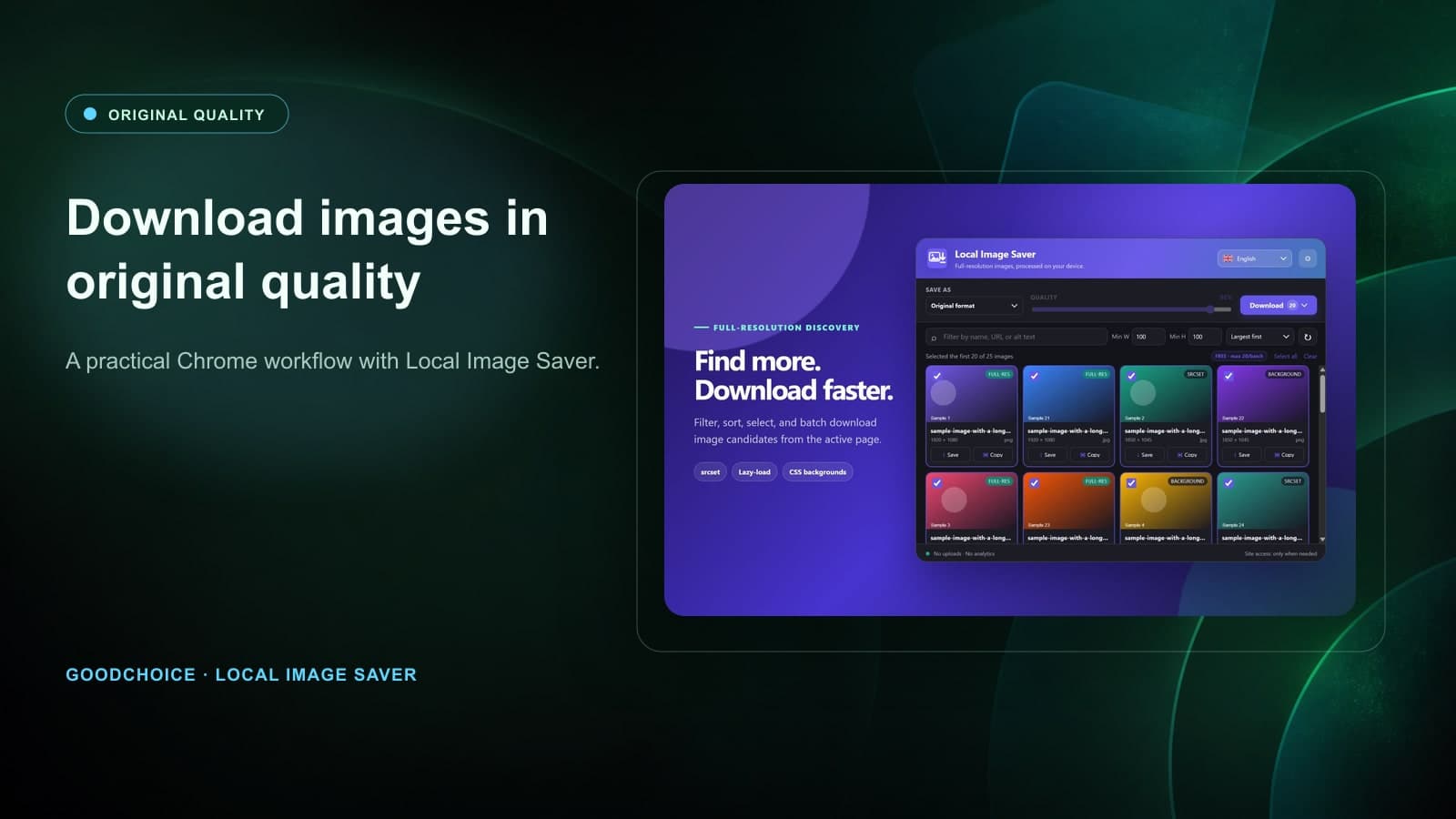
If you need to download images from a website in original quality, the hard part is usually not clicking Download. The difficult part is getting a file that is right for the next job: the right image candidate, the right dimensions, and the right format. A right-click save can quietly give you a small thumbnail, a responsive image variant, or an image optimized for the current layout. It may look fine in the browser but fall apart when used in a presentation, design review, or print mock-up. This guide explains a repeatable Chrome workflow that replaces guesswork with a clear source-and-format decision.
Why this problem keeps appearing in Chrome
Responsive websites often keep several candidates for one visible image. The browser chooses one for the screen, while the page may also expose larger srcset variants, lazy-loaded resources, or original URLs. What you see in the browser is not always the file you should keep. Websites optimize assets for layouts, connection speeds, and device screens. Your job after the download may be very different: add an image to a report, make a design reference, upload a product image, build a presentation, or preserve an asset for later review. A deliberate download workflow gives you control over that handoff.
What the ordinary Save Image command misses
Opening a new tab, inspecting page source, or guessing URL parameters can work for a technical user, but it is repetitive and fragile. It also makes it easy to download the wrong version when filenames are generic. It also hides an important distinction: an image can be displayed at one size while another candidate is available to the page. The filename rarely answers that question. Before you commit to a file, look for practical signals such as preview, dimensions, source variation, and whether the image is a decorative element or the content you came to collect.
A browser-first workflow with Local Image Saver
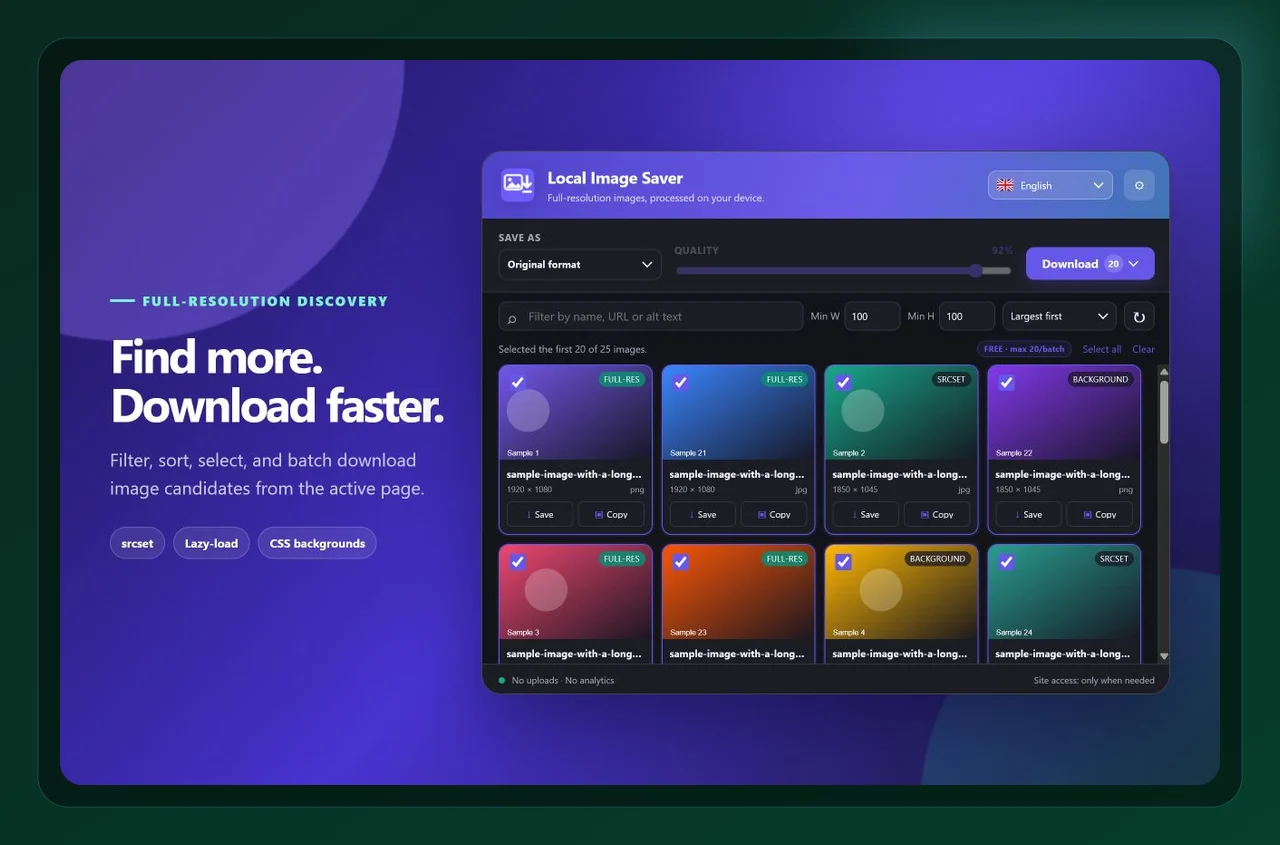
Local Image Saver is built for that decision point. It scans images available in the active page so you can review candidates in one place, then lets you save an original or choose PNG, JPG, or WebP for the selected items. compare discovered candidates by dimensions and preview, then save the version that fits the intended use. Local Image Saver is useful here because source discovery and the download decision are brought into one visual workflow. The key advantage is that discovery, selection, conversion, and download remain in one browser workflow. That reduces context switching and makes it easier to repeat the process across several pages.
Step-by-step: download images from a website in original quality
1. Start with the page and the outcome you need
Scan the current page and sort or filter the discovered images by size. This quickly removes tiny previews from consideration. Before opening the extension, decide what “success” looks like. Is this a source file for an archive, a transparent asset for a designer, a photo for a CMS, or a collection for a research board? That one decision makes the later format and size choices much easier.
2. Review before you download
Inspect candidates with similar names. A large image and a small image can represent the same product, article, or gallery item. This is the moment to slow down briefly. A visual preview tells you more than a file extension, and dimensions help distinguish a usable source from a small derivative. If the page has several similar candidates, save one test file and verify it in the tool where it will actually be used.
3. Save a purposeful output
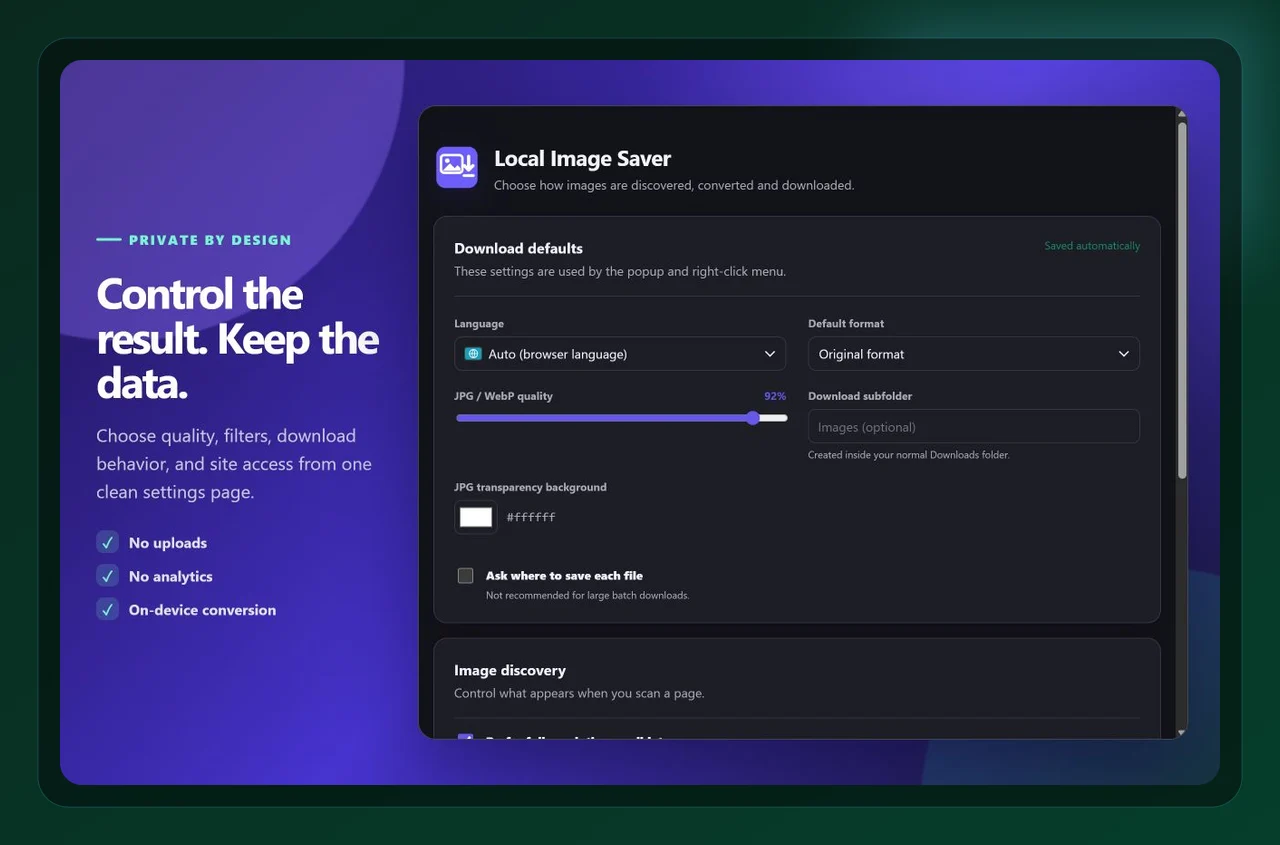
Save the best available candidate in its original format first when archiving, then create a JPG, PNG, or WebP copy only if a later workflow needs it. Keeping an original and a purpose-built working copy is often the most resilient approach. It protects your source while allowing you to meet a specific upload, compatibility, or presentation requirement without retracing the page later.
Choose format and quality deliberately
“Original quality” should mean the best candidate the page makes available, not a promise to manufacture detail. A 1600-pixel source cannot become a truthful 4000-pixel asset simply by converting it to PNG. Format is a workflow decision, not a cosmetic afterthought. Think about the destination first: compatibility, file size, crisp edges, transparency, and future editing. A carefully chosen output saves time later because a teammate can open it, upload it, or place it without another round of conversion.
A quick quality-control checklist
- Check both pixel dimensions and visual sharpness.
- Treat an original file as a source asset; keep it separate from converted copies.
- Do not enlarge a small thumbnail and call it high resolution.
- Use batch selection only after validating one representative image.
- Respect licenses and a site’s terms when reusing downloaded material.
These checks take less time than repairing a poor download later. They also make a workflow easier to hand to another person: the source is clear, the output is intentional, and the destination folder tells the next person what the files are for.
Frequently asked questions
Does a larger file always mean better quality?
No. File size changes with format, compression, and image content. Pixel dimensions and a close visual check are more useful than file size alone.
Can every website expose an original image?
No. A site may only deliver the version it intends to show. The goal is to find the highest-quality candidate available in the active page, not to bypass access controls or create unavailable detail.
Should I convert the original before saving it?
Usually save an original copy first. A converted copy is convenient for a specific destination, while the original gives you a clean reference if requirements change later.
Final takeaway
The practical way to download images from a website in original quality is to make the source, size, and format choices in one place instead of patching them together after the fact. Local Image Saver helps you do that directly in Chrome. Install Local Image Saver from the Chrome Web Store, or learn more about the product, then use the workflow on a real page before relying on it for a larger collection.

Local Image Saver
Save full-resolution images, convert formats in your browser